

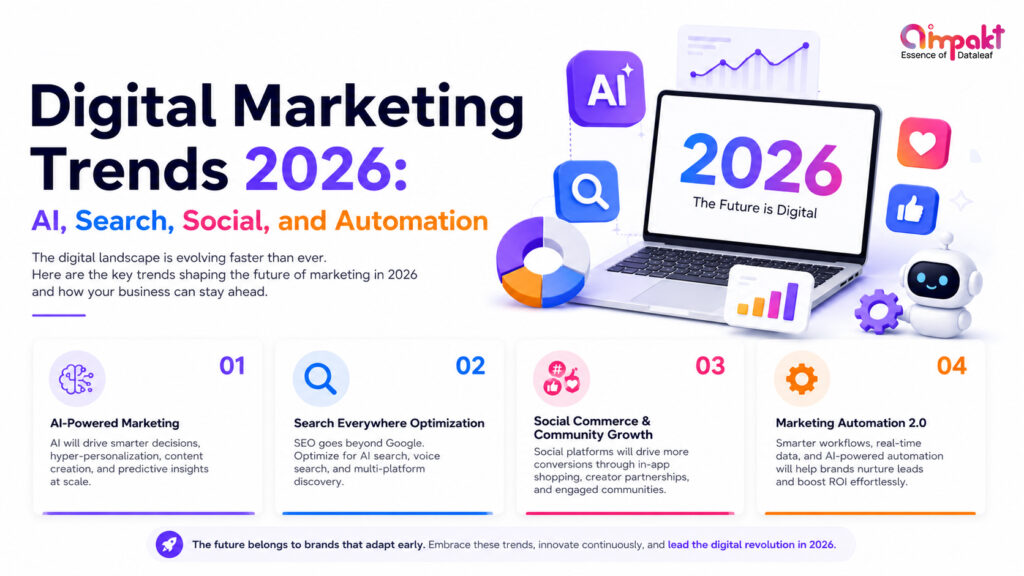
Digital marketing in 2026 is no longer limited to ranking websites, publishing social media posts, or running email campaigns. With the rapid growth of artificial intelligence, users now expect faster answers, personalised recommendations, authentic content, and seamless experiences across search engines, social platforms, websites, and messaging applications.
Understanding these changing expectations is one of the most important Digital Marketing Trends 2026 that companies must consider while planning their marketing strategies.
Users Are Searching for Answers, Not Just Websites
The way people search online has changed significantly after the rise of AI-powered platforms. Users are no longer entering only short keywords. They are asking detailed and conversational questions, such as:
- How can AI improve my marketing results?
- Which digital marketing strategy is best for my business?
- How can I automate social media without losing authenticity?
- What is the best way to generate qualified leads online?
- How can my company appear in AI-generated search results?
Search platforms are becoming answer-driven. Therefore, businesses must create content that directly solves user problems instead of simply targeting individual keywords.
Blogs, FAQs, comparison pages, case studies, service guides, and expert insights will become increasingly important for attracting users with informational and commercial intent.
SEO Is Evolving into AI Search Optimisation
Traditional SEO will remain important, but companies will also need to focus on SEO for AI search.
Businesses want their brand to appear not only in standard Google results but also in AI-generated answers, voice searches, local search results, videos, social platforms, and conversational AI tools.
To improve visibility, companies should publish:
- Original and experience-based content
- Detailed answers to customer questions
- Expert-written industry insights
- Relevant case studies and results
- Clearly structured service information
- Frequently asked questions
- Location-specific landing pages
Publishing a high volume of generic AI-generated content will not guarantee better rankings. Search engines and users will increasingly value trustworthy, useful, and human-focused information.
AI Will Support the Complete Marketing Process
AI is moving beyond content writing. In 2026, companies will use AI to support the complete marketing workflow.
An effective AI marketing strategy may include customer behaviour analysis, audience segmentation, campaign optimisation, content personalisation, lead scoring, predictive analytics, and automated reporting.
AI can help businesses understand which customers are most likely to convert, which campaigns are generating revenue, and which marketing activities need improvement.
However, AI tools must be supported by human creativity, business understanding, reliable data, and strategic decision-making.
Social Media Automation Will Become More Advanced
Social media automation will be one of the most important marketing trends in 2026.
Businesses will use automation for:
- Scheduling and publishing content
- Creating caption variations
- Resizing creatives for different platforms
- Monitoring comments and brand mentions
- Managing chatbot responses
- Routing social media leads
- Optimising advertising campaigns
- Preparing performance reports
However, companies should not automate every interaction. Brand storytelling, creative ideas, customer conversations, and community engagement should continue to have a human touch.
The best approach is to automate repetitive processes while keeping communication authentic and relevant.
Companies Want Connected Marketing Automation
Companies no longer want separate platforms for CRM, email marketing, social media, paid advertising, WhatsApp communication, analytics, and lead management.
They are searching for marketing automation services that connect the complete customer journey.
For example, when a potential customer submits an enquiry, the system should automatically record the lead source, update the CRM, send a personalised response, notify the sales team, schedule follow-ups, and track whether the enquiry generates revenue.
Automation will therefore be evaluated based on business results rather than the number of tasks it completes.
What Companies Will Look for in 2026
Businesses searching for digital marketing services will increasingly look for partners that offer:
- AI-driven marketing strategies
- SEO and AI search visibility
- Marketing automation integration
- Personalised customer experiences
- Original social media content
- Data-driven campaign optimisation
- CRM and lead management automation
- Transparent performance and ROI reporting
Companies will prefer digital marketing partners who understand their business goals and can connect search, content, social media, advertising, analytics, and automation into one measurable strategy.
Conclusion
The future of digital marketing is not about replacing marketers with artificial intelligence. It is about using AI to understand users better, automate repetitive processes, improve customer experiences, and make faster marketing decisions.
Businesses that combine AI, search optimisation, social media automation, human creativity, and reliable data will be better positioned to attract customers and achieve sustainable growth in 2026.