

A prospect downloads your brochure, opens three emails, and replies: “Can this work across our five locations?”
Your marketing automation platform can trigger the next scheduled email. But recognising that this question needs a different response requires more than another trigger.
This is where the discussion around AI agents becomes useful. Businesses should use marketing automation for predictable, repeatable tasks and consider AI agents when the work requires interpreting information and choosing the next step. Often, the strongest setup combines both.
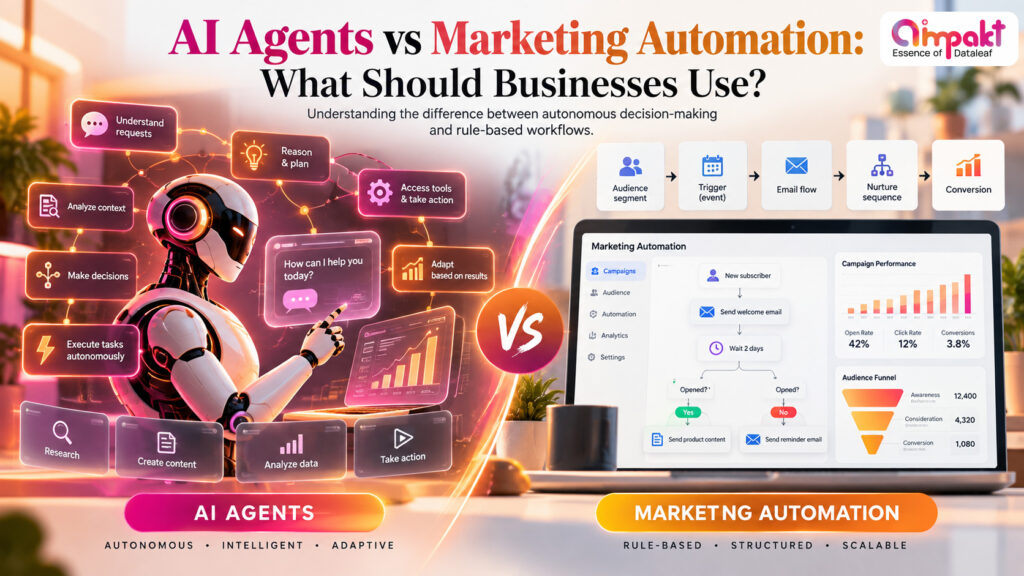
What Is the Difference Between AI Agents and Marketing Automation?
Marketing automation follows predefined rules. When a customer takes an action, the system executes a planned response: send an email, update a contact record, or notify sales.
An AI agent uses an AI model, connected tools, and available information to work towards a specific goal. Within configured permissions, it can assess the situation, decide what action to take next, and adapt its process based on the information it receives. Unlike predefined automation workflows that follow fixed steps, AI agents can dynamically determine how to complete a task.
The distinction is about control, not branding. A platform may include AI-generated subject lines while its customer journey still follows fixed rules.
When Does Marketing Automation Make More Sense?
Choose marketing automation when the sequence is clear and consistency matters.
Welcome emails, appointment reminders, abandoned-cart follow-ups, and renewal notifications usually fit this category. The business already knows what should happen and when.
For example, a manufacturer can automatically acknowledge a product enquiry and assign it to the relevant regional salesperson. There is little value in asking an AI agent to reconsider a straightforward routing rule.
Automation also makes these processes easier to inspect. Teams can trace the trigger, check the conditions, and identify why a message was sent.
Before investing in agents, fix broken forms, inconsistent CRM fields, and missing follow-up rules. More sophisticated technology will struggle with the same gaps.
Where Can AI Agents Add Value?
AI agents are worth testing when inputs vary, and the next step cannot be fully mapped in advance.
Consider a B2B enquiry mentioning delivery timelines, technical specifications, and multiple locations. An agent could review approved product information, identify missing details, and prepare a response for sales to approve.
Another application is campaign investigation. Instead of simply reporting that conversions fell, an agent could examine connected campaign and website data, flag possible explanations and recommend checks.
These are proposed applications, not guaranteed capabilities. Results depend on data access, tool design, and testing. An agent’s explanation should be checked against evidence before it influences spending.
Should Businesses Use Both?
For many businesses, a hybrid approach is practical.
Automation handles dependable execution: capturing enquiries, scheduling follow-ups and updating records. An agent handles selected interpretation tasks, such as summarising an enquiry or preparing a contextual reply.
Keep human approval for consequential actions, including budget changes, pricing commitments and sensitive customer communications.
Start with one workflow and a measurable outcome. For lead handling, track response time, qualified enquiries, correction rates and cost per qualified lead. Faster activity alone does not prove better marketing.
How Should You Choose?
Ask where your team loses time. If the problem is missed repetitive actions, start with automation. If people repeatedly interpret unstructured information before acting, test an agent in that specific step.
At Aimpakt, the starting point is the business problem: what needs to happen, what information supports it, and how success will be measured. To explore a practical approach to AI-driven marketing and business workflows, contact us.