

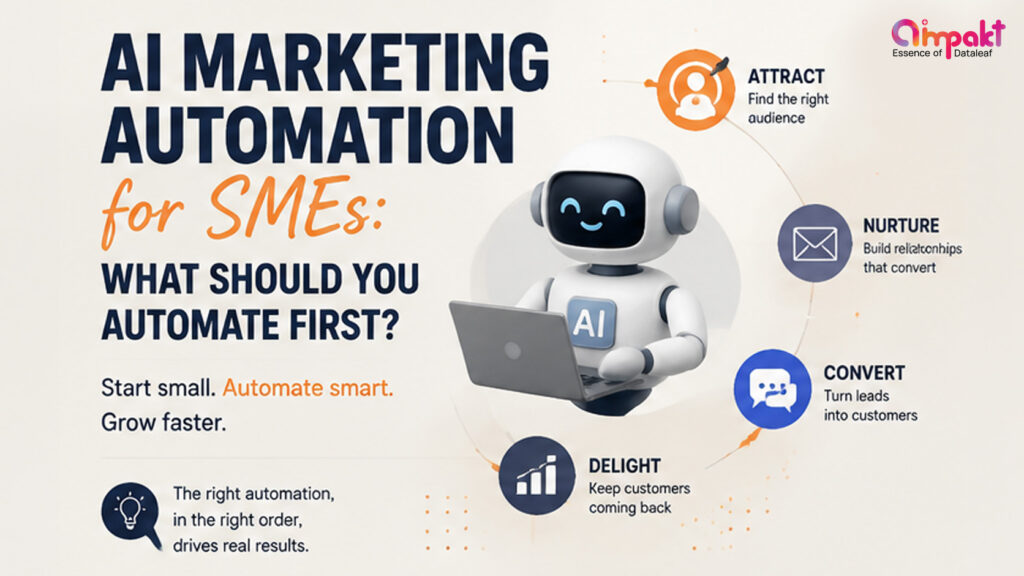
SMEs should automate lead capture, CRM follow-ups, email nurturing, customer segmentation, and marketing reporting first. These activities are repetitive, measurable, and can improve marketing efficiency while preserving human judgement for strategy, creativity, and important customer decisions.
AI adoption among small and medium-sized businesses is growing rapidly as organisations look for practical ways to reduce manual work, improve customer engagement and make better use of their marketing data.
For most SMEs, however, successful AI adoption does not mean automating everything at once. The best approach is to identify repetitive marketing activities that consume time but still follow clear rules and processes.
What Is AI Marketing Automation?
AI marketing automation combines artificial intelligence with marketing technology to automate repetitive activities, analyse customer behaviour and trigger more relevant customer communications.
Common applications include automated email campaigns, lead scoring and qualification, customer segmentation, personalised marketing communication, CRM workflow automation, social media scheduling, campaign performance analysis, predictive analytics and marketing dashboards.
The objective is not to replace marketers. Instead, AI marketing automation helps businesses remove repetitive manual work so their teams can spend more time on strategy, creativity, customer relationships and business growth.
What Should SMEs Automate First?
1. Lead Capture and Qualification
Lead capture should be one of the first marketing processes SMEs automate.
Website forms, landing pages, chat tools, advertising campaigns and other enquiry channels can be connected directly with a CRM so new leads are recorded automatically.
AI-assisted lead scoring can then classify prospects based on factors such as lead source, industry, product or service interest, website behaviour, engagement level, company size and buying stage.
The system can automatically assign leads to the appropriate salesperson, trigger an email response or create a follow-up task.
For example, a B2B company operating across multiple markets could automatically route enquiries according to country, language, industry and service interest before a salesperson responds.
2. Email and Lead Nurturing
Email marketing is another strong starting point for automation because many communications follow predictable customer journeys.
SMEs can automate welcome emails, enquiry follow-ups, event registrations, webinar follow-ups, brochure downloads, re-engagement campaigns, customer onboarding and post-purchase communication.
Instead of manually following up with every prospect, businesses can create automated journeys that send relevant messages based on customer activity.
AI can further improve these workflows by identifying engagement patterns and helping determine which content or communication may be most relevant to different audiences.
3. Customer Segmentation and Personalisation
Traditional marketing often treats large groups of customers in the same way.
AI can help SMEs create more useful audience segments by analysing website interactions, email engagement, purchase history, content preferences, product interest, location, industry and customer lifecycle stage.
Businesses can then personalise communications according to customer type, interest, industry, location, language or buying stage.
For example, a business could show different marketing messages to a new visitor, an existing customer and a highly engaged sales prospect.
Personalisation can make marketing communication more relevant while reducing the amount of manual segmentation required.
4. CRM Follow-Ups and Marketing Workflows
Many SMEs lose opportunities because enquiries are not followed up consistently.
Marketing automation can connect website activity, forms, email campaigns and CRM systems so follow-up actions happen automatically.
A typical automated workflow could look like this:
New enquiry → CRM entry → Lead classification → Welcome email → Sales notification → Follow-up task
Businesses can also automate reminders when a prospect has not responded or trigger different communication based on actions taken by the customer.
Automating these workflows can reduce gaps between marketing and sales while creating a more consistent customer journey.
5. Marketing Reporting and Analytics
Marketing teams frequently spend significant time collecting information from multiple platforms before they can analyse performance.
Reporting automation can bring together data from website analytics, CRM platforms, advertising platforms, email marketing tools, social media, lead-generation campaigns and sales systems.
Automated dashboards can track important metrics such as qualified leads, conversion rates, cost per lead, customer acquisition cost, marketing ROI, campaign performance and customer lifetime value.
AI can support campaign analysis, identify patterns and surface potential opportunities or anomalies.
However, marketers should still interpret what those numbers mean within the broader business context.
What Should SMEs Automate First?
| Automate First | Main Benefit | Human Oversight |
| Lead capture | Faster response | Lead-quality rules |
| CRM follow-ups | Fewer missed opportunities | Sales strategy |
| Email nurturing | Consistent communication | Tone and messaging |
| Customer segmentation | More relevant marketing | Audience strategy |
| Marketing reporting | Less manual analysis | Business interpretation |
Where Should an SME Start with AI Marketing Automation?
Start with two or three repetitive and measurable workflows rather than trying to transform your entire marketing operation immediately.
Businesses should first identify repetitive tasks, select workflows with clear business value, connect their marketing and CRM platforms, clean customer data, and define automation rules.
AI should then be introduced where it can improve analysis, personalisation and decision-making.
Performance should be measured through metrics such as qualified leads, lead response time, conversion rate, customer acquisition cost, customer engagement, revenue generated and customer lifetime value.
What Should You Not Automate Completely?
Not every marketing activity should be fully automated.
Human involvement remains particularly important for brand strategy, creative direction, complex customer conversations, high-value sales opportunities, sensitive communications, strategic decision-making and relationship management.
AI should support marketing teams rather than remove human judgement from areas where context, creativity and trust matter.
What Is the Best AI Marketing Automation Strategy for SMEs?
The best strategy is not to “automate everything.”
Instead, SMEs should follow a practical approach:
Automate repetitive processes first → organise customer data → integrate marketing systems → measure performance → introduce more advanced AI gradually.
When implemented carefully, AI marketing automation can help businesses improve operational efficiency, respond to customers faster, deliver more relevant communications and make better use of marketing resources.
Most importantly, automation should solve a measurable business problem rather than simply introduce another technology platform.
Start Your AI Marketing Automation Journey With Aimpakt
If your business is exploring AI marketing automation, any digital marketing consultant needs Aimpakt to help you identify the right automation opportunities, integrate marketing and CRM workflows, organise customer data and develop a practical AI-powered marketing strategy aligned with your growth objectives.
Aimpakt combines AI, data analytics, digital marketing and automation solutions to help businesses reduce repetitive work, improve customer engagement and make smarter, data-driven decisions.
Ready to explore AI-powered marketing automation for your business? Contact Aimpakt today to discuss your requirements and discover where AI and automation can create the greatest impact for your organisation.