

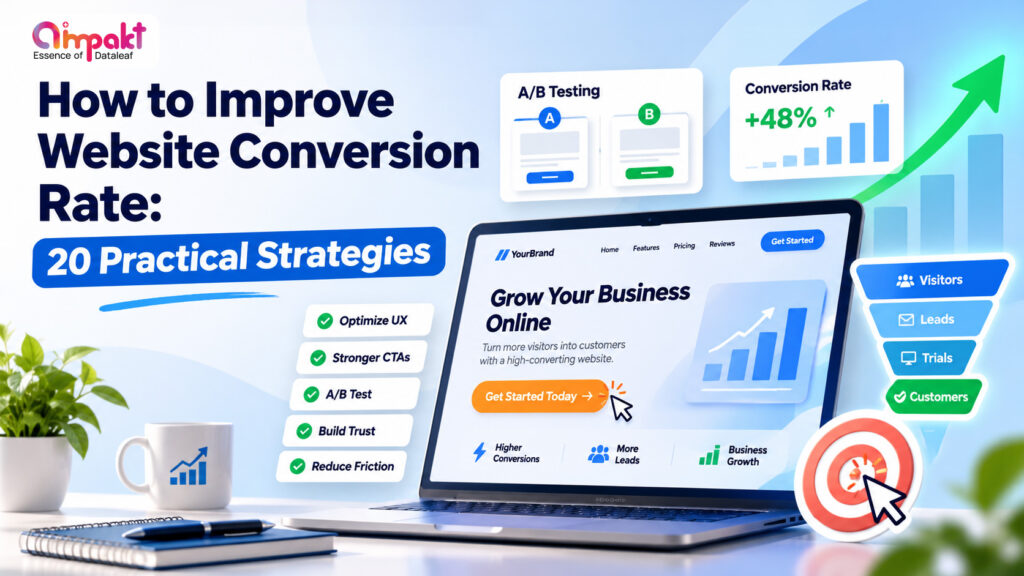
Your website may attract hundreds of visitors daily, but how many actually become customers? Generating traffic is important but converting that traffic into meaningful business opportunities is what drives growth.
Website Conversion Rate Optimization (CRO) focuses on improving your website’s ability to turn visitors into leads, enquiries, subscribers, or paying customers.
Whether you operate an eCommerce store, service-based business, or B2B website, these 20 practical strategies can help improve website conversions without necessarily increasing advertising expenditure.
What Is Website Conversion Rate?
Website conversion rate is the percentage of visitors who complete a desired action, such as submitting an enquiry, requesting a quotation, or purchasing a product.
Conversion Rate = (Total Conversions ÷ Total Visitors) × 100
For example, if your website receives 1,000 visitors and generates 30 enquiries, its visitor-to-enquiry conversion rate is 3%.
20 Practical Strategies to Improve Website Conversion Rate
1. Improve Website Loading Speed
Slow websites discourage visitors. Compress images, optimise scripts, and improve hosting performance to create faster browsing experiences.
2. Create Clear Call-to-Action Buttons
Use action-oriented CTAs such as “Request a Quote,” “Book a Consultation,” or “Get Started” to guide visitors.
3. Optimise Your Website for Mobile
Ensure responsive layouts, readable typography, accessible navigation, and mobile-friendly forms across different screen sizes.
4. Simplify Website Navigation
Organise services, products, and important pages logically so visitors can quickly find relevant information.
5. Build Trust with Customer Testimonials
Showcase genuine customer reviews, project success stories, and client experiences to strengthen credibility.
6. Improve Landing Page Relevance
Align landing page headlines, content, and offer with the keywords or advertisements bringing visitors to your website.
7. Use Compelling Headlines
Communicate your main value proposition immediately. Explain what your business offers and why customers should care.
8. Reduce Form Fields
Request only essential information in enquiry forms to minimise friction and encourage more submissions.
9. Display Contact Information Clearly
Make phone numbers, email addresses, and contact options easily accessible throughout your website.
10. Strengthen Your Value Proposition
Highlight your differentiators, industry expertise, service quality, and measurable benefits rather than relying on generic marketing claims.
11. Add Relevant Visual Content
Use authentic photographs, demonstrations, product images, and explanatory videos to communicate your offerings effectively.
12. Optimise Product and Service Pages
Include detailed descriptions, benefits, specifications, FAQs, and relevant CTAs to support informed purchasing decisions.
13. Use Strategic Internal Linking
Connect related services, blogs, and landing pages to help visitors discover solutions and navigate their buying journey.
14. Incorporate Live Chat Support
Offer convenient assistance through live chat or messaging channels to address questions during decision-making.
15. Improve Website Content Readability
Use concise paragraphs, descriptive headings, bullet points, and straightforward language to make information easier to understand.
16. Conduct A/B Testing
Compare different headlines, CTA placements, page layouts, and forms to identify changes that improve conversion performance.
17. Analyse User Behaviour
Use GA4 and Microsoft Clarity to evaluate engagement, visitor journeys, abandonment patterns, and potential usability issues.
18. Add Relevant FAQ Sections
Answer common customer questions directly. Well-structured FAQs can improve usability and help search and AI systems interpret your content.
19. Strengthen Website Credibility
Display relevant certifications, transparent policies, authentic case studies, and verified business information to build visitor confidence.
20.Continuously Monitor Conversion Performance
Track conversion rates by traffic source, device, and landing page. Prioritise improvements using measurable results rather than assumptions.
How Can SEO, AEO, and GEO Support Website Conversions?
SEO (Search Engine Optimization) attracts relevant organic visitors through targeted keywords, technical improvements, and helpful content.
AEO (Answer Engine Optimization) makes information easier to discover through direct answers, structured headings, FAQs, and appropriate schema markup.
GEO (Generative Engine Optimization) improves how clearly AI-powered discovery systems can understand your business through accurate information, credible evidence, and consistent brand messaging.
Together, these approaches can improve qualified visibility, while CRO helps convert that visibility into business opportunities.
Conclusion
Improving website conversion rates requires more than attractive design. Speed, usability, relevant content, trust signals, and continuous testing all influence conversion performance.
Start by identifying your biggest conversion barriers, implement targeted improvements, and measure their impact.
Is your website attracting traffic but struggling to generate quality enquiries?
Aimpakt Mediatek helps businesses strengthen their digital presence through website development, SEO, performance optimisation, and conversion-focused digital marketing strategies.
Contact us today to explore opportunities to improve your website’s performance and generate more meaningful business enquiries.