

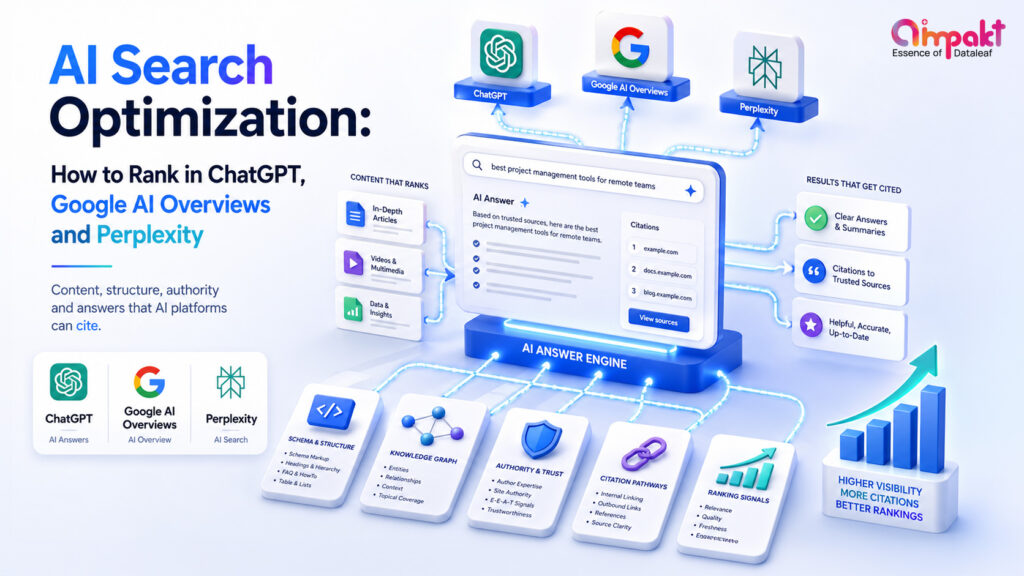
AI Search Optimization makes website content easier for search engines and AI answer platforms to discover, understand, verify, and cite. It combines Search Engine Optimization (SEO), Answer Engine Optimization (AEO), and Generative Engine Optimization (GEO).
The objective is not only to rank for keywords but also to become a dependable source that ChatGPT, Google AI Overviews, and Perplexity can reference when answering relevant questions.
What Is the Difference Between SEO, AEO and GEO?
SEO improves visibility in traditional search results. AEO structures information to answer user questions directly. GEO strengthens the authority, context and evidence that generative AI systems may use when selecting and citing sources.
These approaches work together. Google’s generative search experiences rely on established search ranking and quality systems, which means technical SEO, useful content and website authority remain important foundations.
The Clear Framework for AI Search Visibility
The CLEAR framework Crawlability, Logical Answers, Evidence, Authority and Relevance—provides a practical structure for improving visibility across traditional and AI-powered search platforms.
- Crawlability
Important information should be published in indexable HTML rather than hidden inside images, scripts or inaccessible page elements. Websites should use descriptive title tags, contextual internal links, XML sitemaps and mobile-friendly layouts.
Review the website’s robots.txt file, firewall settings and security plugins to ensure legitimate search and AI crawlers are not accidentally blocked. For ChatGPT Search, websites should allow OAI-Search Bot. For Perplexity visibility, they should also allow Perplexity Bot and verify its requests against official crawler information.
- Logical Answers
Place a clear and concise answer immediately below every question-based heading. Use definitions, numbered steps, short paragraphs, bullet points, and comparison tables where they improve readability.
Each section should address one specific search intent without requiring readers to review the entire article. Self-contained answer passages make content easier for users to scan and simpler for AI systems to interpret.
- Evidence
AI platforms are less likely to cite generic content that repeats information available across hundreds of websites. Add original research, first-party data, expert observations, practical frameworks, industry examples or verified client outcomes.
Important claims should be supported by credible sources. Display the author’s name, professional experience, publication date and last-reviewed date. Never use invented statistics or unsupported claims simply to make the article appear authoritative.
- Authority
Create detailed author profiles that explain the writer’s expertise and link to other relevant articles. Keep the brand name, services, author information, and business details consistent across the website and credible third-party platforms.
Add relevant structured data, including Article, Organization, Person or Profile Page, and Breadcrumb List schema. Structured data helps search systems understand the relationship between the content, author, and organization, although it does not guarantee rankings or AI citations.
- Relevance
Build focused topic clusters instead of publishing unrelated articles. A website covering AI search optimization could publish supporting content about AEO strategy, GEO content structure, AI referral tracking, schema markup, entity optimization, and AI search audits.
Connect these pages through contextual internal links. Regularly review and update them so that statistics, examples, platform recommendations, and technical instructions remain accurate.
How Should AI Search Performance Be Measured?
AI search performance should be measured using a combination of organic visibility, citations, branded searches, referral traffic, engagement, and conversions.
Track whether important pages appear as cited sources in ChatGPT, Google AI Overviews, and Perplexity. Review referral sessions in Google Analytics and monitor pages receiving traffic from AI platforms. ChatGPT search referral URLs may include utm_source=chatgpt.com, making this traffic easier to identify.
Businesses should also maintain a list of high-value questions they want their brand to appear for. Test these prompts regularly and record which websites, authors and content formats are being cited.
Conclusion
AI search visibility comes from being accessible, clear, evidence-based, authoritative and relevant. Combining SEO foundations with answer-first writing, original expertise, structured data and consistent entity signals gives content a stronger opportunity to be discovered and cited across ChatGPT, Google AI Overviews and Perplexity.
No platform can guarantee citations. However, businesses that publish useful, verifiable, and technically accessible content are more likely to build long-term visibility across traditional and AI-powered search experiences.
Want to improve your brand’s visibility across Google and leading AI search platforms? Contact Aimpakt today to improve your brand’s visibility across Google and AI-powered search platforms.